Issue #172 – The Moody Blues
A day under three years separated THE MOODY BLUES’ ‘Go Now!’ topping the UK charts and Days Of Future Passed entering them. During that time, they underwent the most prolonged, tortured evolution of all the British groups that traded beat and blues for psychedelia. It took so long that that the peak of their Denny Laine-led fame and the dawn of their psych-prog pomp neatly bookend the 1965-67 golden era of British music – an era they spent exiled in pop’s hinterlands.
SHAUN HAND untangles the true story of the Moodies’ ’60s metamorphosis
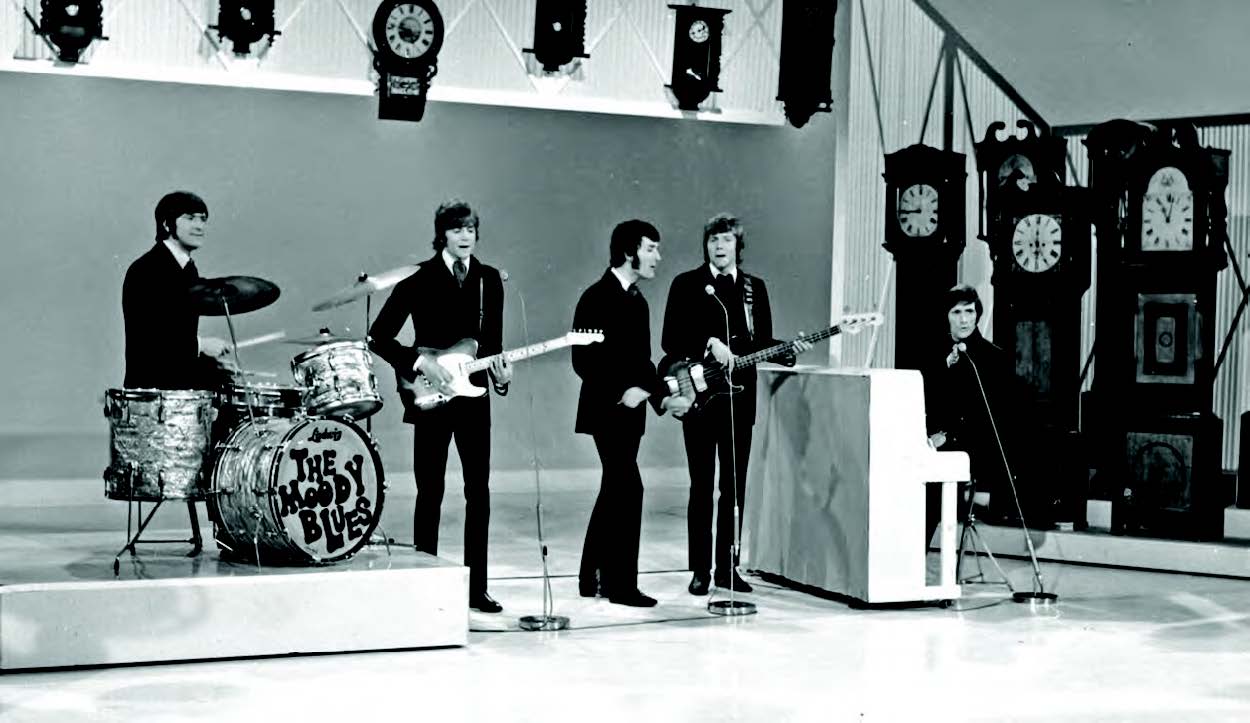
As 1967 dawned, hopes of a fresh start were dashed when Decca, looking to recoup losses, issued two Laine-era recordings, ‘Life’s Not Life’ and ‘He Can Win’, on 45. It wasn’t a bad single on its own terms, but against the tougher contemporary likes of, say, The Move’s ‘Night Of Fear’ and The Spencer Davis Group’s ‘I’m A Man’, it sounded quaint (or, if you believe The Evening Standard’s review, “like an Oriental Beach Boys”).
One of many myths to grow up in Moody Blues lore states that, by March 1967, the group had been reduced to performing cabaret for a 10th of the fee they’d commanded just 18 months earlier. They hit rock bottom when they were confronted by an angry punter backstage in Stockton-on-Tees (there’s that town again) who told them they were the worst band he’d ever seen, reducing Hayward and Thomas to tears. On the drive home, they resolved to quit cabaret, ditch the suits and cover versions and follow their hearts; lo, the stars aligned and Days Of Future Passed soon emerged.
Except it didn’t happen like that. It’s a great story, but the timeline is far less linear – and multiple retellings have pulled the tangled truth into a permanent knot. The Moodies certainly spent the early part of the year gigging, mainly around the West Midlands (a ballroom at Dudley Zoo, an Easter “rave” at a golf club), but there’s no record of them playing in Stockton at that time. And even if they did, they were only now embarking on their descent into the scampi-and-cigar-smoke horrors of cabaret.
The first recorded fruits of the new line-up’s labours came in late April when Decca released ‘Fly Me High’. Produced by Tony Clarke, who would be with them for the next 11 years, it was the sprightliest thing they’d released in ages (Slade later covered it on their debut album). They performed it for BBC’s Saturday Club and reviewers dutifully penned variations on “It should return them to the hit parade,” but it didn’t.
On 26th May, Sgt Pepper hit the shops. The following evening, the Moodies began a three-night stint at The Princess Theatre in Torquay, in the first half of a variety show headlined by Lonnie Donegan. Their brief set still included ‘Go Now!’. If one moment encapsulated the band’s distance from their Fab touring mates, from the whole counterculture zeitgeist, it was that weekend. It’s tempting, if voyeuristic, to imagine them huddled round a Dansette in their hotel, hearing the album for the first time. Swinging London must have felt way, way behind them.
To read the whole story order issue #172 here. Subscribe to the mag here.