Shindig! Issue #177 – The Tokens
New York journeymen THE TOKENS rose to fame in 1961 with a couple of oldies staples, before forging a unique path that saw them establish their own record label and publishing company and write and produce dozens of hits and misses, only to see the artistic outpouring of Intercourse – an album born from depression, yet vibrantly coloured by the melting pot that was the ’68 music scene – rejected by their short-sighted paymasters.
As the album’s first ever vinyl reissue hits shelves, ANDY MORTEN ties together the threads of their complex story
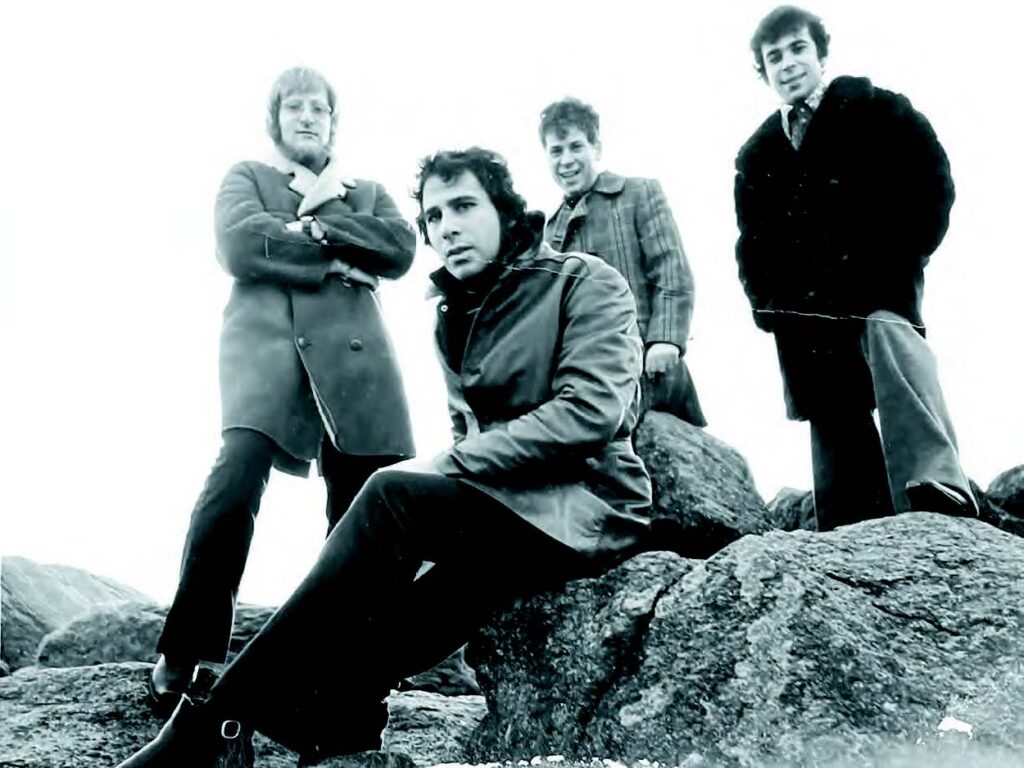
Nineteen sixty-eight rolled round with neither of The Tokens’ last two singles – a curious, fractured spin on Marvin Gaye’s ‘Ain’t That Peculiar’ and an ‘It’s A Happening World’-aping revisit of Charles Danvers’ ’56 oldie ‘Till’ – attracting airplay or attention.
“I was probably the most depressed I’ve ever been in my life,” Mitch Margo confessed in 1995. “I was so young when I wrote those songs,” he later told Steve Stanley. “It was therapy for me, out of being depressed.” Yet despite low morale, frustration and depression, Jay, Hank, Phil and Mitch were about to play their wildest card yet.
First came ‘Mr Snail’, a March ’68 single credited to Margo, Margo, Medress & Siegel, on which Sgt Pepper/Magical Mystery Tour vibes are upended by musicians who had clearly been gorging on The Beach Boys’ Smiley Smile. “If I had to name two influences on us at the time, I’d say Brian Wilson and The Beatles”, Phil Margo told Steve Stanley. “When I first heard Sgt Pepper, I wanted to quit the business. I said, ‘I can’t equal that. I can’t get near that.’”
Two months later came The Tokens’ ‘Animal’, an even more hopped-up slice of avant-rock that gives contemporary troublemakers like The Turtles and the aforementioned Zappa a run for their money. “‘Animal’ was a #1 record in St Louis,” Phil claimed. “Warners couldn’t get it on the air in other places. KMOX played it. We went to St Louis and we were like superstars.
“It would make a great record today (2003),” he continued, adding soberly, “Mitch writes in very juxtaposed ways. He’ll say, ‘Drop dead’ one time, then he’ll say, ‘It’s amazing to be alive’ the other. This is the conflict, I guess, that Mitch lived with at the time.”
Not only did ‘Animal’ bomb, it confirmed Warners’ opinion that The Tokens were a “good-time, happy group” not a slick modern rock machine with a subtle line in “fuck yous” (“Hard-bitten, wise-cracking New Yorkers,” as Stanley reminds us). September’s follow-up – an inexplicable revival of Trinidadian folk standard ‘The Banana Boat Song’ – was clearly another ill-judged attempt to exploit the now-seven-year-old success of ‘The Lion Sleeps Tonight’.
The Tokens had spent much of ’68 pursuing their increasingly esoteric, inward-looking craft, with little or no outside interference, at Olmsted Sound Studios on East 54th Street, just round the corner from their office on 53rd. “We played all the instruments ourselves, except for maybe some horn overdubs,” said Mitch, proudly. When they presented their new album as a fait accompli, Warners rejected it outright. They were crushed. “Maybe because we wanted to call it Intercourse,” Mitch speculated. “Maybe because there was a cut on there called ‘Commercial’, which was a commercial for marijuana. Maybe there were things going on that I didn’t know anything about.” Phil’s diagnosis was more prosaic: “I think Warners turned us down because they didn’t expect that kind of music from us.”
For all its qualities – its strangeness, its lo-fi heat, its acceptance and celebration of introspection and mental illness, its occasionally devastating musical and vocal beauty – the 16 tracks that make up the original, intended Intercourse, some as short as 15 seconds, were clearly going to prove impenetrable for a panel of Hollywood suits perusing the new Everly Brothers or Petula Clark album. Yet from today’s standpoint, where once-lost or overlooked artefacts like The Beach Boys’ SMiLE, Alexander Spence’s Oar, Jim Sullivan’s UFO and The Millennium’s Begin are now commonplace in our music libraries, Intercourse felt like a missing-in-action entry in such hallowed company until CD editions began emerging in the mid-90s and inquisitive listeners opted in.
“There’s a lot of personal stuff in that album, you know?” Jay Siegel emoted. “A lot of personal stuff. Every song on that album was different, from ‘Bathroom Wall’ to ‘I Could Be’. ‘Some People Sleep’ – that’s some of the best Tokens harmonies on that song.”
To read the full article buy issue #177 here Subscribe here.